 Reach. Build. Grow.
How AI Could Create New Jobs for Ghanaian Youth in 2026
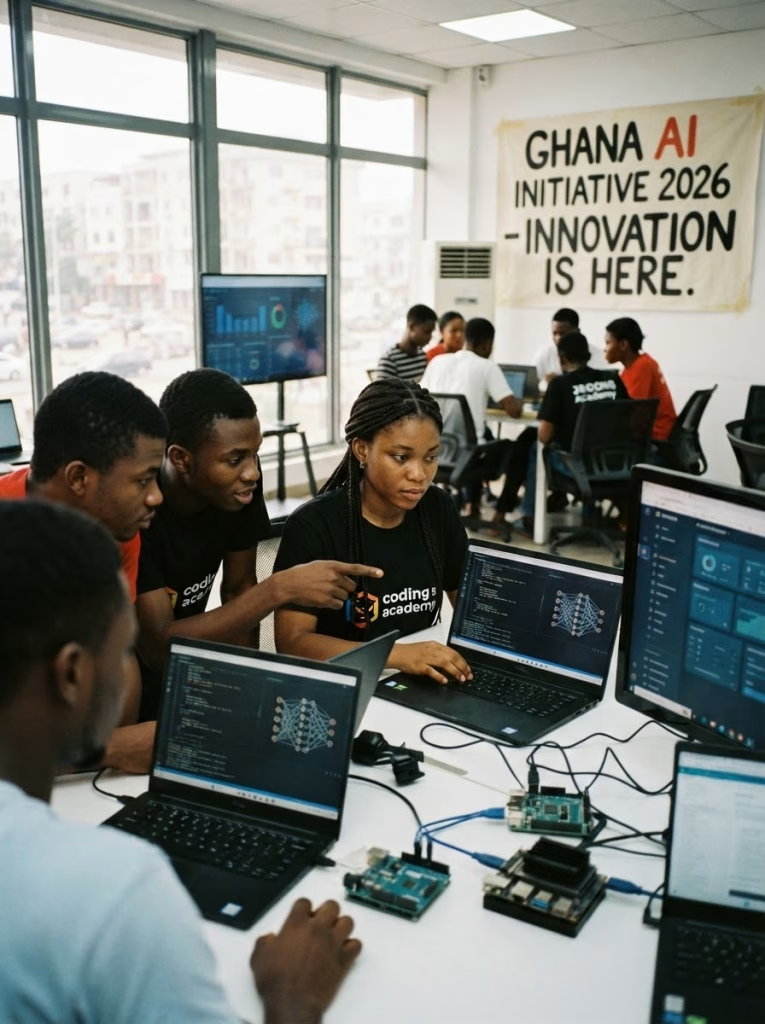
Ghana has a jobs problem and an AI opportunity — at the same time.
Youth unemployment for ages 15-24 averaged 32.5% across 2025, more than double the national average. Every year, 500,000 young people enter the labour market.
But in April 2026, Ghana launched its National Artificial Intelligence Strategy (2023-2033) with a $270 million commitment. AI adoption has been growing at 28% per year since 2017.
The government wants to train one million coders. Japanese firm Degas is investing $100 million to make Ghana Africa’s first AI-powered agricultural hub.
The question is not whether AI will change jobs in Ghana. It is whether young Ghanaians will be ready to capture the new ones.
This guide breaks down where the jobs are, what skills you need, and how to start.
The Reality: Ghana’s Youth Jobs Crisis in Numbers
Let us start with the facts:
• 500,000 youth enter Ghana’s labour force every year. By 2030, Ghana will have about seven million young workers.
• 32.5% youth unemployment (ages 15-24) in 2025, according to the Ghana Statistical Service.
• 21.5% of young people aged 15-24 are not in employment, education, or training (NEET).
• The World Bank warns that the public sector — where many job seekers want to work — can only absorb a small fraction.
The old path — finish school, find a government job — cannot work for everyone. AI is creating a new path.
Ghana’s $270 Million AI Bet: What It Means for Jobs
On 24 April 2026, President John Dramani Mahama launched Ghana’s National AI Strategy. Here is what matters for job seekers:
1. National AI Computing Center — $250 million
A world-class computing facility to give Ghanaian developers and startups the infrastructure to build AI solutions locally, instead of importing them.
2. Strategy execution — $20 million
Funding for AI education, youth employment programs, and public-sector AI adoption across health, agriculture, finance, and education.
3. Eight pillars
Covering AI education, digital infrastructure, data governance, applied research, and sector transformation.
Officials project AI could add up to $20 billion to Ghana’s economy over the next decade.
What jobs could this create?
• Software developers and AI engineers
• Data analysts and data scientists
• Cybersecurity specialists
• AI prompt engineers and data annotators
• Digital entrepreneurs and content creators
• Agri-tech field officers
• AI trainers for local languages (Akan, Ewe, Ga, Dagbani)
The World Bank notes that over 9 million jobs in Ghana could require digital skills by 2030.
5 Practical Ways AI Is Already Creating Work in Ghana
1. One Million Coders Programme — Free Training
The Ministry of Communication, Digital Technology and Innovations is training one million Ghanaians in coding, cybersecurity, networking, and data analytics over four years.
As of September 2026: 140,000 registered, 10,000+ completed.
How to benefit: Watch for constituency-level rollouts. Training covers cybersecurity, data analytics, networking — skills employers pay for.
Related: One Million Coders Explained: How to Apply
2. AI in Agriculture — Jobs on the Farm and Off It
Agriculture employs most Ghanaians but is the least digitised. That gap is now an opportunity.
• Degas Ltd has financed 86,000+ smallholder farmers across 122,000 acres, doubling incomes with a 95% repayment rate, using AI satellite monitoring.
• FarmSense AI by Sesi Technologies boosts yields up to 60% with real-time soil analysis.
• 3Farmate’s FAMA robot plants and fertilises autonomously.
New roles: drone operators, soil data collectors, agri-tech sales agents, farm management app trainers.
3. 24-Hour Economy Startup Loans — GH₵5,000 to GH₵500,000
Young Ghanaians aged 18-35 can apply for startup loans under the 24H+ programme, plus free digital skills training through TVET centres and guaranteed internships.
This is ideal for AI-powered side businesses: digital marketing agencies, mobile money agent networks with analytics, e-commerce stores.
4. Freelancing for the Global Market
With a laptop and skills from One Million Coders, a young person in Kumasi, Tamale, or Ho can serve clients abroad — data annotation, customer support automation, content creation, no-code app building.
Ghana’s mobile penetration exceeds 113%. Internet penetration is 69.9%. The infrastructure exists.
5. AI in Public Services and Fintech
318 fintech startups operated in Ghana as of August 2025. Mobile money now exceeds traditional banking for many uses. AI is needed for fraud detection, customer service chatbots in local languages, and credit scoring.
Skills Ghanaian Youth Need for AI Jobs in 2026
You do not need a computer science degree to start. Employers want:
Foundational (start here):
• Digital literacy and prompt engineering
• Data entry and data cleaning
• Social media marketing + analytics
• Mobile money and e-commerce tools
Intermediate:
• Python basics
• Data analytics (Excel, Power BI)
• Cybersecurity fundamentals
• No-code AI tools
Advanced:
• Machine learning
• Cloud computing
• AI product development
Free or low-cost paths: One Million Coders, YEA x Ghana Digital Centres Microsoft-certified micro-degrees in AI and cybersecurity, TVET centres in all 16 regions.
How to Start This Week: A 5-Step Action Plan
1. Register for One Million Coders via your MP or district assembly. Ask about the next cohort.
2. Apply for the 24H+ Expression of Interest if you have a business idea — even a small one.
3. Learn one AI tool deeply — e.g., how to use AI for market research, CV writing, or farm advice.
4. Build proof — volunteer to digitise a local business, farm cooperative, or church records.
5. Join a hub — MEST, Ghana Tech Lab, or your regional TVET centre for network and mentorship.
Will AI Take Jobs Too?
Yes — some tasks will be automated. Customer service scripts, basic data entry, and routine admin are at risk.
But Ghana’s bigger risk is not replacement, it is missing out. If young Ghanaians do not build AI skills, someone else will fill those remote roles.
The strategy is producer-led, not consumer-led: Ghana wants to build AI, not just use imported tools.
Conclusion
Ghana’s youth employment crisis is real. But for the first time, there is a coordinated national push — $270 million, a 10-year strategy, one million training slots, $100 million for AI farming — aimed at creating the skills and infrastructure for new work.
AI will not solve unemployment automatically. Young people who learn to use it, build with it, and solve Ghanaian problems with it will have an advantage in 2026 and beyond.
Next read:How AI Is Helping Ghanaian Farmers Double Their Incomes | Fostering Entrepreneurship: Cultivating Ghana’s Business Landscape
───
Published by RichmondBash.com — Ideas + Ghana + Future + Opportunity + Technology + Community. For feedback: richmondbash@gmail.com
Comments