 Reach. Build. Grow.
How AI Is Helping Ghanaian Farmers Double Incomes (2026 Guide)
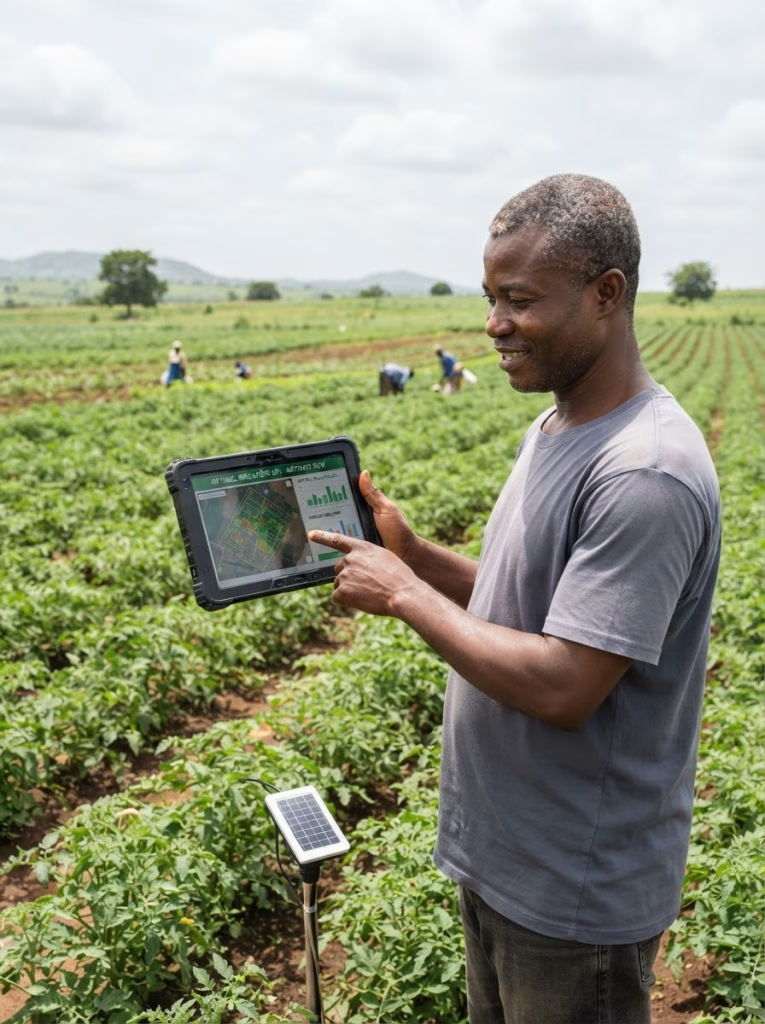
Agriculture employs the majority of Ghanaians. Yet it has been the least digitised sector — until now.
In August 2025, Japan’s Degas Ltd committed $100 million over four years to make Ghana Africa’s first AI-powered agricultural hub. Already, Degas has financed more than 86,000 smallholder farmers across 122,000 acres, helping double farmer incomes with a 95% repayment rate.
Meanwhile, Ghanaian startups like Sesi Technologies report up to 60% yield increases with AI soil sensors. A farming robot built by university students can plant and fertilise on its own.
This is not future talk. This is happening on Ghanaian farms in 2026.
Why Ghanaian Farming Needed AI
Smallholder farmers — who make up over 80% of Ghanaian farmers — face the same problems:
Not knowing soil health without expensive lab tests
Pests like fall armyworm destroying maize before detection
No access to credit because banks cannot verify farm size or crop health
Post-harvest losses and poor market prices
Climate unpredictability
AI solves these with data.
1. The $100M Bet: Degas and Satellite Farming from Space
Degas Ltd combines AI-driven satellite monitoring with precision agriculture and farmer financing.
How it works:
Satellites scan thousands of acres, monitoring crop health, soil moisture, and predicted yields
AI flags pest outbreaks and drought stress before they are visible on the ground
Farmers get agronomy advice via mobile
Lenders use satellite data to verify crops and approve loans
Insurance can trigger automatic payouts when drought is confirmed
Results: 86,000+ farmers financed, 122,000 acres covered, incomes doubled, 95% repayment rate.
President John Dramani Mahama secured the commitment at TICAD 9 in Yokohama in August 2025, saying it would “strengthen value chains from inputs to markets, improve food security, and create more jobs for our youth.”
Ghana’s National AI Strategy (launched 24 April 2026) lists agriculture as a priority sector, aiming for AI tools trained on Ghanaian soil, rainfall, and crop cycles.
2. FarmSense: 60% Yield Boost from Ghanaian Soil Intelligence
FarmSense, built by Ghanaian startup Sesi Technologies with KNUST’s DIPPER Lab and launched October 2025, is AI-powered soil intelligence.
A handheld device measures pH, electrical conductivity, moisture, and temperature. AI models trained on local Ghanaian conditions give instant fertilizer recommendations and crop advice.
Impact: Up to 60% yield increase, reduced fertilizer waste, lower emissions.
Backed by the UK’s RISA Fund, FarmSense is rolling out with farmer training on soil health and productivity, plus an MoU with Agrinvest to transform youth agriculture.
For a farmer who never knew their soil pH, this is transformative.
3. FAMA Robot: Ghana’s First AI Farming Robot
Built by 3Farmate founders Clinton Anani and Elijah Ocupualor from a university dorm room, FAMA is an AI-powered autonomous robot that plants seeds, applies fertilizer, weeds, and sprays — without human intervention.
Unlike GPS-dependent robots, FAMA uses vision-based AI to see crop rows and navigate, critical for rural areas with poor satellite coverage.
In April 2026, the Ministry of Food and Agriculture endorsed the shift from “hoe and cutlass” to modern tech, citing 3Farmate as a leading example.
Business model: Pay-per-use service, so smallholders do not need to buy the robot.
4. Pest Detection Before It Is Too Late
Fall armyworm and cocoa diseases devastate yields. AI now sees what humans cannot:
Drones scan cocoa farms in Ashanti Region, detecting pod lesions early
Pezego AI gives maize farmers real-time pest thresholds and localized advice
CNN models detect cocoa diseases with high accuracy
Farmerline’s Mergdata serves 2.2M farmers across 48 countries with AI disease detection
Early detection means less pesticide, lower cost, and protected export access under EU deforestation rules.
5. Cocoa and Blockchain Traceability
Cocoa is Ghana’s top agricultural export. New AI + blockchain platforms provide GPS traceability from farm to buyer — now required for EU imports.
This protects farmer incomes and Ghana’s market access.
What This Means for Youth Jobs in Agriculture
AI farming is creating new rural jobs:
Drone operators and satellite data agents
Soil testing agents (FarmSense)
Agri-tech sales and field officers
Farm data collectors
Cold-chain and logistics coordinators for e-commerce
The 24H+ programme includes agro-ecological parks and supports youth in agribusiness with loans from GH₵5,000 to GH₵500,000.
How Farmers Can Start with AI in 2026
Join a Degas-supported farmer group — ask your district agriculture office about Degas financing in your region
Try FarmSense testing — contact Sesi Technologies or Agrinvest for soil testing demos
Use free AI advisory — Farmerline Mergdata, AyaGrow, and Darli AI (27 languages, 110,000 farmers)
Join a cooperative — priority for 24H+ loans goes to cooperatives
Learn basic digital skills — One Million Coders includes agri-tech relevant tracks
Challenges to Be Honest About
Rural connectivity and power remain unreliable
Most AI tools are English-only, despite 80+ Ghanaian languages
Data costs limit usage
Smallholders need training, not just apps
The National AI Strategy targets these with expanded rural connectivity and local-language datasets.
Conclusion
AI will not replace Ghanaian farmers. It is giving them superpowers — seeing soil health instantly, spotting pests from space, accessing credit without collateral.
With $100M committed, 60% yield gains proven, and a national strategy behind it, 2026 is the year AI farming moves from pilot to scale.
Read next: How AI Could Create New Jobs for Ghanaian Youth in 2026 | One Million Coders Ghana: How to Apply
RichmondBash.com — Ideas + Ghana + Future. Contact: richmondbash@gmail.com
Leave a Reply
You must be logged in to post a comment.